


地點
United Kingdom
資格
Bachelor of Science (with Honours) - BSc (Hons)
費用
GBP17600
(2026)
時長
3 Year(s)
下個學年
21.09.2026
入學成績
6
IELTS考試COURSE_INFO
As our economics degrees share a common first year, you’ll gain a solid foundation in economic concepts, principles, analysis, techniques and knowledge and, if you choose Introduction to Financial Economics as an option, you may be eligible to change to the Financial Economics course at the start of your second year. A variety of optional modules also enable you to tailor your studies to suit your interests, for example you can choose specialist economics modules in the digital economy, in international trade, money banking and finance. You can also choose option modules in other areas of the business school such as entrepreneurship, human resource management, marketing or accounting. Our degree also offers the flexibility of studying one language module per year.
Professional recognition
The Chartered Institute of Management Accountants (CIMA) is the world's largest professional body of management accountants offering the most relevant accounting qualification for a career in business. If you are considering a career in finance and business, the CIMA qualification will open doors with employers all over the world.
This course will give you the opportunity to apply for up to 4 exemptions entering into the CIMA operational level.
Careers
This highly practical course aims to prepare you to use economic reasoning, mathematical and statistical analysis, to analyse and evaluate financial performance and public policy issues. You’ll develop a range of transferrable skills useful in almost any career, including excellent communication, strategic and logical thinking.On graduation, you can target a role as an economist, financial or commercial analyst, or choose to pursue a broader career in government departments, banking, risk and insurance, investment and broking firms, retail and manufacturing firms, the media, social work or the voluntary sector.
Past economics graduates have secured roles as economic consultants, management trainees, investment bankers, professional accountants and within the Government Economic Service. Increasing numbers of students progress to further study on graduation: either taking professional qualifications (in accountancy, finance, for example) or proceeding to a specialist Master’s degree in the economics or finance area.
Job roles
This course will prepare you for roles such as:
Account manager
Actuarial analyst
Assistant economist
Business analyst
Commercial project manager
Commodities analyst
Data analyst
Economist
Financial advisor
Investment analyst
Journalist
- 獎學金 查看所有獎學金
- 實習
入學要求 University of Westminster, London
A levels \u2013 BBC (112 UCAS Tariff points)
T levels \u2013 112 UCAS Tariff points
International Baccalaureate \u2013 112 UCAS Tariff points from all components of the Diploma Programme. International Baccalaureate Career-related Programme will be considered on a case-by-case basis
BTEC Extended Diploma \u2013 DMM
BTEC Diploma \u2013 D*D*
Access \u2013 112 UCAS Tariff points from the Access course
In addition to one of the above, you should have:
GCSE English Language grade 4/C \u2013 IB grade 4 Higher Level, GCSE Maths grade 4/C \u2013 IB grade 4.
If your first language is not English, you will need an IELTS of 6.0 overall, with 5.5 in each component. TOEFL \u2013 78 overall with a minimum of 17 in Listening, and Writing, 18 in Reading and 20 in Speaking.
申請截止日期
申請截止日期無法使用 與升學顧問對談 了解更多細節資訊
Further information
If you aren't eligible for the above entry requirements, you might have a chance to explore pathway options at University of Westminster, London. If you want to find out more, speak to our counsellors.
Chat to a student ambassador
Speak to IDP ambassadors today!

Aastha Paudel

Geraldine Penarete Vaquiro

Yumi Wan

Tiara D Souza
Your study abroad community
Discover genuine experiences and practical tips from IDP student ambassadors and peers worldwide.

推薦給你
- 泰晤士高等教育世界大學排名 (THE):162
- Undergraduate
- St Andrews , United Kingdom
- 下個學年:07.09.2026
- 入學成績: IELTS考試 7
- GBP30160 (2026)
- 泰晤士高等教育世界大學排名 (THE):801
- Undergraduate
- Kingston Upon Thames , United Kingdom
- 下個學年:21.09.2026
- 入學成績: IELTS考試 6.5
- GBP20363 (2026)
- 泰晤士高等教育世界大學排名 (THE):301
- Undergraduate
- Colchester , United Kingdom
- 下個學年:08.10.2026
- 入學成績: IELTS考試 6
- GBP20500 (2026)
- 泰晤士高等教育世界大學排名 (THE):134
- Undergraduate
- London , United Kingdom
- 下個學年:01.09.2026
- 入學成績: IELTS考試 6.5
- 泰晤士高等教育世界大學排名 (THE):601
- Undergraduate
- Greenwich , United Kingdom
- 下個學年:14.09.2026
- 入學成績: IELTS考試 6
- GBP17500 (2026)
- 泰晤士高等教育世界大學排名 (THE):301
- Undergraduate
- London , United Kingdom
- 下個學年:14.09.2026
- 入學成績: IELTS考試 6.5
- GBP17620 (2026)
- 泰晤士高等教育世界大學排名 (THE):501
- Undergraduate
- Bradford , United Kingdom
- 下個學年:14.09.2026
- 入學成績: IELTS考試 6
- GBP19560 (2026)
- 泰晤士高等教育世界大學排名 (THE):201
- Undergraduate
- Guildford , United Kingdom
- 下個學年:28.09.2026
- 入學成績: IELTS考試 6.5
- GBP21800 (2026)
- 泰晤士高等教育世界大學排名 (THE):118
- Undergraduate
- Leeds , United Kingdom
- 下個學年:28.09.2026
- GBP28250 (2026)
- 泰晤士高等教育世界大學排名 (THE):401
- Undergraduate
- Camden , United Kingdom
- 下個學年:21.09.2026
- 入學成績: IELTS考試 6.5
- GBP21990 (2026)
Your action plan
步驟 1
Shortlist your courses
Choose the best three courses you’re most likely to pursue.
步驟 2
Check your eligibility
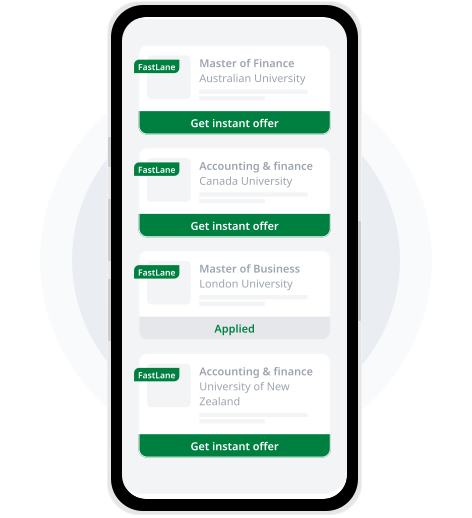
Get an instant in-principle offer for courses with the IDP FastLane tag.
步驟 3
Apply through IDP Live
Fill out the form once and use it to apply to multiple courses.
IDP FastLane 如何運作?
通過FastLane的「原則性錄取通知」,你將在幾分鐘內知道自己是否獲取錄!
 1
1選擇一個院校機構和課程
 2
2建立你的學術個人檔案
 3
3提交你的「原則性錄取通知」申請
 4
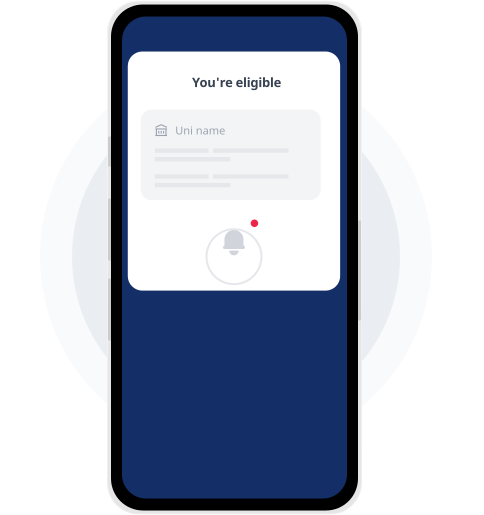
4你選擇的機構將會在幾分鐘內發送結果!
 5
5與升學顧問一起準備申請