


Location
United States
금액
USD64614
(2026)
지속 기간
8 Semester(s)
다음 입학시기
27.08.2026
입학 조건
7
IELTSCOURSE_INFO
At the University of Virginia, undergraduate courses in transportation engineering focus on geometric design, pavement design, road user and vehicle characteristics, traffic studies and urban transportation planning. Computer methods are introduced and applied in many transportation applications. Complementary courses include probability and statistics and systems engineering courses. This transportation curriculum provides an excellent introduction to the methodology of transportation systems analysis and design.
The field of transportation engineering is comprised of two main streams of development: technology and planning. Technology is critical to the understanding of the function of the system, in predicting its performance and its costs, and in identifying alternatives in the form of fixed plant investments as well as operational changes. Planning methods are critical to long range plans and short-term system management problems, such as energy shortages and air pollution. The opportunities in transportation engineering appear to be excellent in the future. Graduates may be employed by governmental agencies, private companies, railroads, shippers, or transportation consultants. The transportation program at the University of Virginia is a flexible one that will prepare the student for a wide choice of careers. Civil Engineering is the broadest of all engineering professions and encompasses the application of science and technology to the planning, design, analysis, construction, operation and maintenance of the infrastructure and natural environment. Civil engineers are the fabricators of modern society and the protectors of our environment. Civil engineering program emphasizes the complex interrelationships between infrastructure, social systems, and the environment. We develop civil engineers who will seek to sustainably and equitably design, management, and construct infrastructure systems, and who are prepared to innovate with new materials and create and use digital and virtual technologies. Civil infrastructure is diverse, including many subsystems such as stormwater and drinking water systems, waste management systems, neighborhoods, highways, railways, high-rise buildings, and bridges. We develop the insight to anticipate how changes in one subsystem may affect the others and ultimately the environment, energy systems, communities, and the quality of life.
- 장학금 모든 장학금 보기
- 인턴쉽
수업료에 관한 내용은 참고용으로만 사용해주세요 정확한 비용을 알기 위해
Duration: 8 Semester(s)
Fees: USD64614
| 학기 | Location |
|---|---|
| Fall (August), 2026 | Charlottesville |
입학 요건 University of Virginia
신청 마감일
지원 마감일이 없습니다. IDP 유학전문 카운셀러에게 문의하기 더 자세한 정보를 위해
Further information
If you aren't eligible for the above entry requirements, you might have a chance to explore pathway options at University of Virginia. If you want to find out more, speak to our counsellors.
Chat to a student ambassador
Speak to IDP ambassadors today!

Dima Tokarenko

Aastha Paudel
Geraldine Penarete Vaquiro

Yumi Wan
Your study abroad community
Discover genuine experiences and practical tips from IDP student ambassadors and peers worldwide.

추천
- 세계랭킹:166
- Undergraduate
- Charlottesville , United States
- 다음 입학시기:27.08.2026
- 입학 조건: IELTS 7
- USD64614 (2026)
- 세계랭킹:166
- Undergraduate
- Charlottesville , United States
- 다음 입학시기:27.08.2026
- 입학 조건: IELTS 7
- USD64614 (2026)
- 세계랭킹:166
- Undergraduate
- Charlottesville , United States
- 다음 입학시기:27.08.2026
- 입학 조건: IELTS 7
- USD64614 (2026)
- 세계랭킹:166
- Undergraduate
- Charlottesville , United States
- 다음 입학시기:27.08.2026
- 입학 조건: IELTS 7
- USD64614 (2026)
- 세계랭킹:112
- Undergraduate
- Amherst , United States
- 다음 입학시기:03.09.2026
- 입학 조건: IELTS 6.5
- USD39683 (2026)
- 세계랭킹:64
- Undergraduate
- Davis , United States
- 다음 입학시기:23.09.2026
- 입학 조건: IELTS 6.5
- USD41196 (2026)
- Undergraduate
- Chicago , United States
- 다음 입학시기:10.08.2026
- 입학 조건: IELTS 6.5
- USD30400 (2026)
At The Catholic University of America \u2013 Globally Recruit
- 세계랭킹:801
- Undergraduate
- Chicago , United States
- 다음 입학시기:25.08.2026
- 입학 조건: IELTS 6.5
- USD57630 (2026)
- 세계랭킹:151
- Undergraduate
- College Station , United States
- 다음 입학시기:24.08.2026
- 입학 조건: IELTS 6
- USD20914 (2026)
- 세계랭킹:1001
- Undergraduate
- San Jose , United States
- 다음 입학시기:17.08.2026
- 입학 조건: IELTS 6.5
- USD21010 (2026)
Your action plan
절차 1
Shortlist your courses
Choose the best three courses you’re most likely to pursue.
절차 2
Check your eligibility
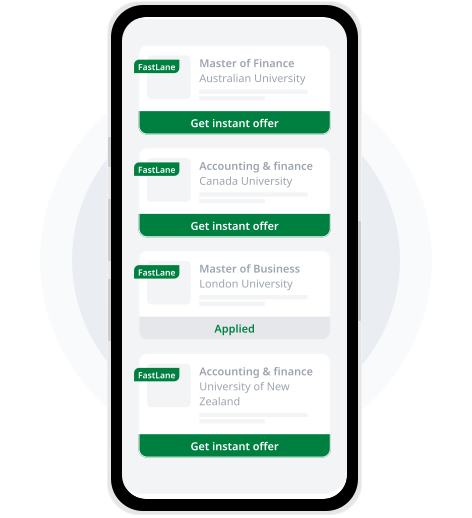
Get an instant in-principle offer for courses with the IDP FastLane tag.
절차 3
Apply through IDP Live
Fill out the form once and use it to apply to multiple courses.
IDP의 Fastlane은 어떻게 진행되나요?
FastLane의 사전입학심사 서비스를 이용하면 몇 분 안에 합격 가능여부를 알 수 있습니다!
 1
1학교와 전공 선택하기
 2
2지원을 위한 계정 만들기
 3
3사전심사서비스를 위한 지원서 제출
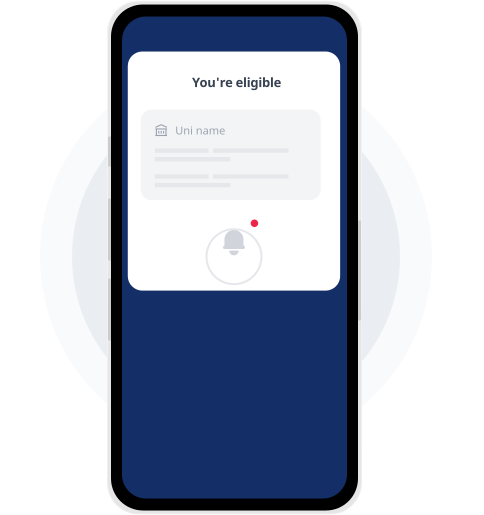 4
4선택하신 학교에서 몇 분 내로 사전심사 결과를 보내드립니다
 5
5전문 카운셀러와 함께 지원준비하기